
Haunted by Dora Maar
And meeting Adam Gopnick in the Kitchen


Welcome to another chapter of Flight, my memoir about my first year of traveling around Europe in search of a new life, after leaving my old one as a professor, wife, and mother in New Orleans in 2022.
The full chapter is available to paid subscribers. (Everyone can read a preview below.) I’m so grateful for your support, and I could not be more thrilled to share this story with you!
Subscribe to Audacious Creative Lives to receive free posts every other Saturday. Upgrade to paid to read all content, including Flight, the Memoir delivered to your inbox every Thursday, and reflections on writing and sharing Flight, plus travel recommendations, every other Saturday.
You can catch up here anytime with the full list of chapters, updated as they appear.

But you can also just read the installments that interest you or that you have time for. They pretty much all stand alone. So feel free to read on without catching up at all, if you wish.
In the last installment, I arrived in Menerbes, France, in Provence, and moved into the home of Dora Maar, who was a Surrealist photographer and one of Picasso mistresses. Her house is now run as a residency for writers and artists. It was a dream come true to have a full month there to write. But it was also a struggle to have so much time on my own.
Now on to this month, as I get to know my host, Dora Maar herself.
Living With Dora
It takes me a few days to find my way around the maze of high-ceilinged rooms in Dora Maar’s house. I spend most of my time on the second floor—a large kitchen, a library/dining room, a drawing room, and a sitting room with a vast fireplace you can stand up in. The rooms are always empty.


But also they are not. Someone else is here. I decide that it’s time I got acquainted with my host, Dora Maar.
#
The library off the kitchen has two massive wall-to-ceiling bookcases and two smaller ones full of books about twentieth-century art and culture. There is a Dora Maar shelf—or third of a shelf. She shares it with Picasso, who takes up the rest and spills over onto other shelves.
Unfortunately, nearly all of the books about her are in French, including what seems to be the only authoritative biography. There are only three books about her in English. All of them include Picasso in the title or subtitle.


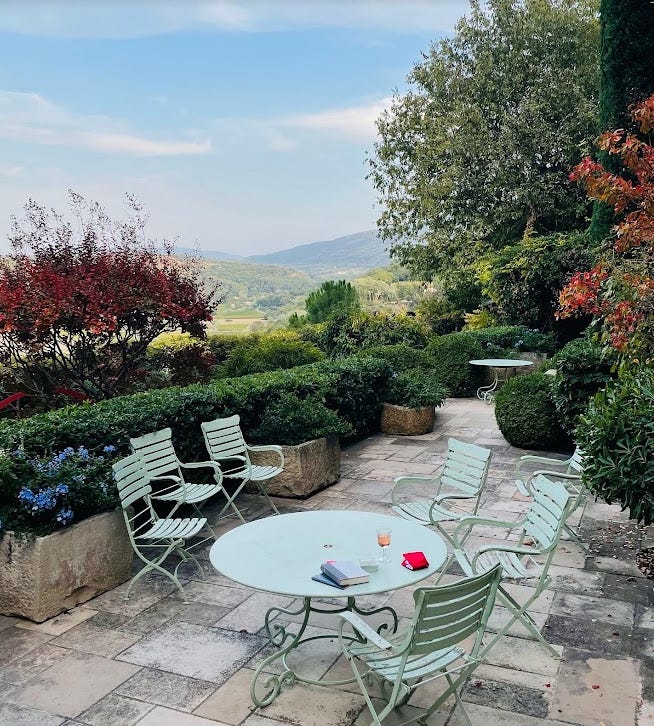
I take them out to the terrace and sit at the pale green metal table, which jiggles when I place them down. The morning air is cool, the sky above clear blue. I’m surrounded by hedges and trees. Behind me, orange-turning vines climb the stone wall (it’s October). I can hear a truck is down shifting up the hill.
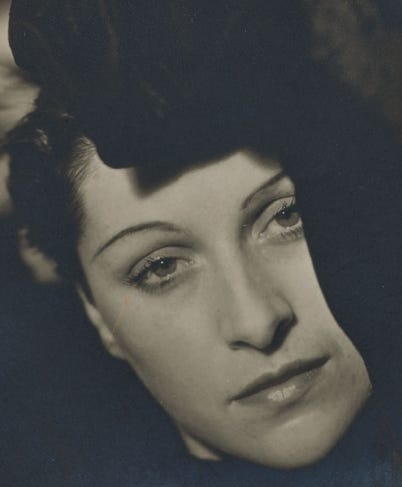
I open the first book and read about her childhood in Argentina, her twenties studying in Paris, but mostly about her alluring beauty. She liked to wear Schiaparelli hats and often held her cigarette holder aloft with meticulously manicured hands—her long nails were brightly painted red, green, or purple, ending in sharp points. Her hair was dark, her eyebrows pencil-thin. In her portraits she never smiles but looks dreamily or stonily into the distance. In all of them she looks almost blank, as if she is wearing a beautiful mask.
This is Dora Maar the model, the aesthetic object. But she was also a well-regarded photographer in her own right, exhibiting in major exhibitions alongside Salvadore Dali and Man Ray. She was friends with the Surrealists Paul Eluard and André Breton and their wives. Her most famous photographs are of a ghostly armadillo fetus, a woman’s hand emerging from a shell, and a woman’s face overlaid with a spider’s web.


The main event of her life, however, according to these books, is her relationship with Picasso. One day in 1934, at the café Deux Magots, she got his attention with a game of daring that entailed stabbing a knife between her fingers and drawing blood. He asked for her stained glove as a memento. With a beginning like that, it’s not surprising to see that the next chapter is called “L’amour fou.” Mad Love.
