
Journaling Changed My Life
Has it ever changed yours?

For years I couldn’t bring myself to keep a journal. I was too afraid of what I might actually write. I knew that if how I really felt was there in front of me, in black and white, I’d have to face it. It was easier to pretend everything was fine, that I was fine, that life could carry on as normal.
But then in the fall of 2020, what had become a daily habit of thinking on the page (this was during the pandemic, when I actually had time to sit on the porch with a cup of coffee and a journal in the morning) became something more. I began to feel on the page too. I began to admit to myself how unhappy I was, how desperate I was for change.
I have a lot of thoughts about journal writing that I’ve been wanting to share with you. After deciding what to do with my old journals on a recent trip back to the U.S., I thought now was a good time. But first, a little bit about what else is going on here at Audacious Creative Lives.
This week is a free newsletter for all where I share stories about my current life on a new creative path after thirty years in academia and living abroad after most of a lifetime in the U.S. If you’re new here, make sure to subscribe to get every issue.
If you’d like to read how I quit my old life and moved abroad, starting with a year of travel, you can upgrade your subscription to join the serialization of my memoir about my first year of travel around Europe after leaving my old life in New Orleans.

This Sunday, June 14, is the Sunday Salon, where we’ll have the chance to meet each other and share what we’ve been reading lately. Upgrade your subscription if you’d like to join us and receive the list of reading recommendations that comes out of it. Everything you need to know, including the link, is in my most recent post for paid subscribers:

Can Journaling Change Your Life?
As I said, in the fall of 2020 I began to write down what I was really feeling for the first time in many, many years. I can look back now and see that was the beginning of the end of my old life.
It is not an exaggeration to say that journaling changed my life! If I hadn’t started to find an outlet for the feelings that were bubbling up inside of me and starting to come out in my dreams, I don’t think I would have been able to start to move in the direction of change.
So many of us feel stuck in our lives. We have this feeling that things aren’t right, but we aren’t sure what’s wrong or how to fix it. Part of the problem is that we are stuck in a kind of haze, or a maze too complicated to see our way out of. Writing our way through it can change everything.
Socrates said the unexamined life is not worth living. You could say, though, that not examining your life means you’re not really living it. A journal can serve many purposes, but holding up a mirror to life—outside and inside—is perhaps its most important function.
The pandemic gave me the time to start journaling, and then over many months the practice evolved from just writing about what I was doing, my plans for the day, more like a diary than a journal, into something deeper. I couldn’t help it, to be honest. The pressure from inside was too great. And thankfully I had my journal to pour my feelings into.
I hadn’t wanted to know what was in my mind or in my heart. I was afraid of letting what was inside me rise to the surface. Once it became language, I feared that it could ignite, like how the substance phosphorous catches fire when it’s exposed to the air.
Within three months of starting to tell the truth to myself in my journal, I told my husband that I wanted a divorce. By spring, I was formulating a plan to leave my career as a professor to move abroad when my daughter left for college.
What would happen if one woman told the truth abouther life?
                        The world would split open

                                  --Muriel Rukeyser, "Käthe Kollwitz"
What to Do with Your Old Journals
I kept writing and writing in the coming years. When I left the U.S. in September 2022, two years after that first beginning, I had about ten journals that I put in a box in my mother’s basement. I prayed that no one would ever find them or, God forbid, read them.
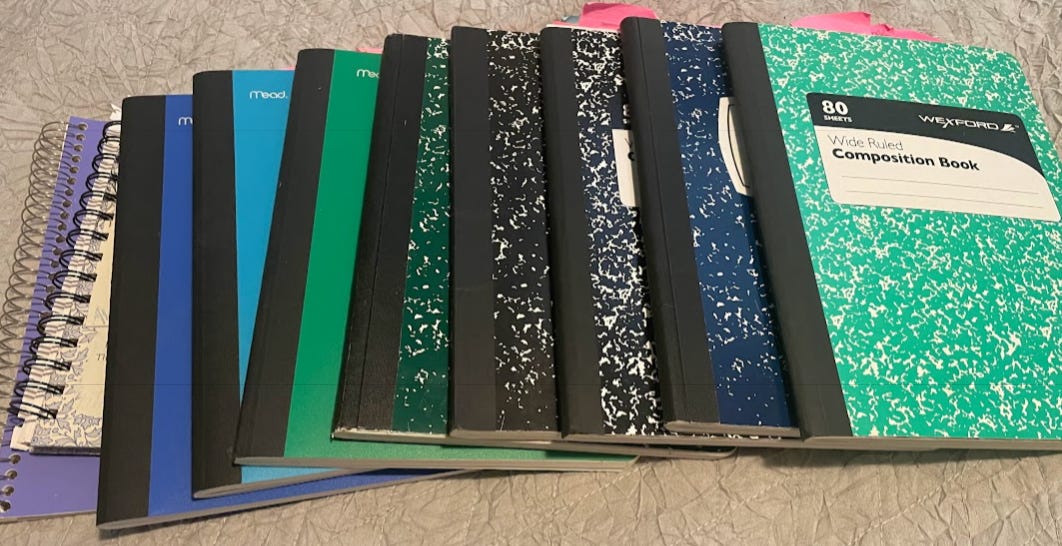
The thing that keeps many of us from writing down our true feelings is the fear of someone else reading them. You have to banish that thought and write only for yourself, if you really want to get the benefits of a journaling practice. But then what do you do with them?
You don’t actually have to save your journals. A friend of mine back in New Orleans would write down something that she was feeling or thinking about on a piece of loose paper and set it by her bed. She would read it and think about it for a few days and then, when she was done with whatever it was, she was dispose of it. I love that! There is no reason that a journal has to become some kind of archival document.
Long before I kept my own journals, I felt very differently. As a researcher and biographer, I treasured private writings and thought they should be carefully preserved.
When I was writing my biography of the writer Constance Fenimore Woolson, I lamented that she and Henry James had destroyed their letters to each other. What I wouldn’t have given for a handful of those letters or even the briefest of journals in her own hand. Imagine, her pure unadulterated thoughts and feelings, a glimpse into her true self!
After my grandmother died, I was pained to learn that my aunt had thrown away the journals she had found. I was so upset, as if my grandmother had died all over again. It took me quite a few years to realize that if she had wanted me to read them, she would have told me about their existence. But she hadn’t destroyed them herself, so naturally I was curious. Who was she really, behind the facade that we all wear for the world?
Now, having kept many volumes of my own journals, I get it. If anyone found mine, I would hope they would destroy them. And I totally understand why Woolson wanted one of her dearest friends to destroy her letters to him. She once said that she wanted to be able to write freely. And that is how I wrote my journals. That is where the therapeutic benefits come in. That is how I came to know myself. But I wouldn’t want anyone to open a page and think, oh, here she is, the true Anne Boyd. Because a person—a life—is so much more complex than the feelings they may have had on any given day.
Looking back at my journals from 2020-2022, when I wrote pages every day, pouring out the messy, complicated feelings I was having, trying to figure out what was making me so miserable, I can see that who I was then is no more. Some of them are painful to read, because I was in so much pain. I don’t feel that way anymore. Yet, I still carry that person I was inside me. She is just one part, though, one of many.
What I Decided to Do with My Journals
When I was back in the U.S. a few weeks ago, I decided to take care of the problem of the stack of journals in the basement that I didn’t want anyone to read. My mom has a shredder, so I cut the pages out and shredded them. All of them.
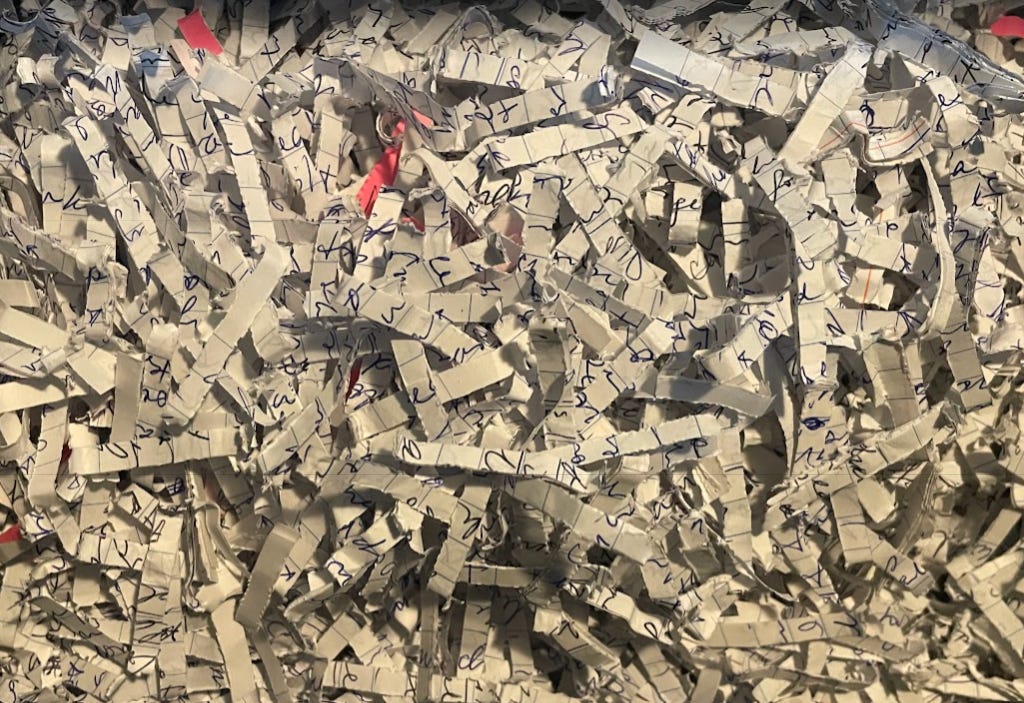
I didn’t simply destroy them, though. I have scans of them all on my computer, which I had made before I first left the U.S. in 2022. I thought I might use them someday in my writing. I haven’t, at least not yet. Although I did use the journals from my travels, starting in Sep. 2022, to write the memoir I am serializing here.
These days I don’t journal as much as I used to. Frankly, I kind of O.D.’d on it. I got to where examining my navel everyday wasn’t necessarily helping me. Now I write when I feel the pressure building inside, letting off the steam before it backs up and threatens to explode, like it did in 2020.
I’ve also been attending Tanya Lynch’s Lunchtime Journaling with Ease Club. (It’s free to paid subscribers to her Substack.) She is wonderful on all things journaling and its therapeutic benefits, and she is helping me explore new ways to keep a journal and make it an important part of my everyday life. Here are some great tips from her:

Lastly, here’s the expert on journaling, Anais Nin:
“We write to be able to transcend our life, to reach beyond it. We write to teach ourselves to speak with others, to record the journey into the labyrinth. We write to expand our world when we feel strangled, or constricted, or lonely…When I don’t write, I feel my world shrinking. I feel I am in prison. I feel I lose my fire and my color. It should be a necessity, as the sea needs to heave, and I call it breathing.” — Anaïs Nin
Do you keep a journal? If you don’t journal, what holds you back? If you do, how consistent are you with the practice? Have you found it beneficial? Have you ever found that it changed your life?
Do you have stacks of old journals lying around? Are you worried about someone reading them? What do you think you’ll do with them?
I look forward to hearing your thoughts about journaling!
Until next time,
Anne
P.S. If you enjoyed this post, please click on the heart at the bottom or the top of this email/post and help others discover Audacious Creative Lives. And it helps me know what kinds of content you value, which is important to me!
Anne Boyd was a literature professor in New Orleans for 23 years before embarking on new life abroad as a creative writer. She is the author or editor of seven books. She has been writing this newsletter since December 2022. You can learn more about her on her website.
So insightful. Lovely essay Anne and thanks for the mention.
My jaw dropped when I saw the shredder! I find it so interesting how we all have different ways of dealing with our old journals. At the front of mine journal I write “enter at your own risk” 😉
I have journals dating back to the early 1990s, and some from the 1980s. Some years I was not so conscientious, but other years I obviously needed to have my life journalled. I recorded events and people, dumped negative feelings and reframed them, sorted out my life, made plans, practised writing, made notes, collected quotes, reviewed books etc. I have no idea what to do with them. There must be dozens of them. I just did a rough calculation and came up with 190!!
Part of me doesn't want to get rid of them - when I pick one up to read, lots of memories come flooding back, but there's an awful lot of emotion dumps in them as well some of which I read now and am embarrassed. Was I ever so young and foolish?
When I saw your picture of the mulched paper, I thought you could use that to make things out of paper mache. But that still means destroying the journals. It is a problem. I guess I will need to leave instructions in my will, but at the moment I don't know what they would be!